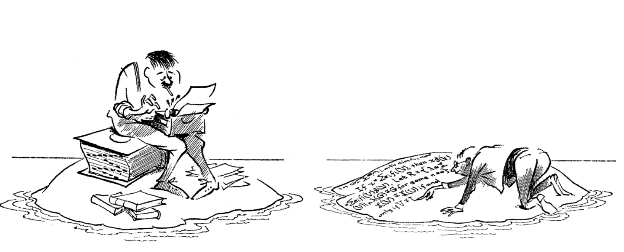
The Great Divide
By Cindy Zeng ’27
At Milton, we no longer feel that it is possible or encouraged to excel in both STEM and the humanities. We think that being a “biology kid” precludes you from writing a cogent history paper and that the doors of higher mathematics are forever shut for those unenlightened disciples of English—not to mention the idea that, if you are an accomplished student athlete, you must have sacrificed all hope of intelligence to shave a few more milliseconds off your 100m record. Specialization has become the order of the day. We declare our intended majors upon arrival and work to construct a list of extracurriculars and research opportunities that best showcase our single-minded drive.
“Two Cultures.” That is what C.P. Snow, British novelist and chemist, called the notion that knowledge has been irrevocably divided into two ever-widening realms, the scientific and the humanistic. I reject this divide. Both disciplines are, at their core, approaches to make sense of what we do not yet understand about the world. Whether we write up lab reports or critical essays is merely a formality. When we examine the scientific method—observe, hypothesize, test, repeat—it is as much an attempt to constantly and recursively interrogate and express something as essay writing. Categorizing them as disciplines that do not inform each other is dangerous: when we forget that we care about the advancement of technology to improve human lives, we get Palantir.
Especially at Milton, I believe we must reject this divide. Milton boasts a liberal arts education, meaning that we prioritize breadth across disciplines instead of depth in a specific field as you would in, say, graduate school. This pursuit manifests in our academic requirements: mandatory Biology, United States History, and four years of English, among others. Milton students have nevertheless found ways to circumvent this system built to prevent us from specializing in a certain field by “doubling up” in our favorite subjects.
Specialization renders us illiterate to other disciplines that too paint a version of reality as real as our own. Someone who does not see Newton’s laws of motion or calculus as part of how the world works is missing the whole picture of reality as much as someone who does not believe fiction and poetry can communicate human truths because they are not subjectively true.
Some believe that knowledge is doomed to splinter. J. Robert Oppenheimer (better known for other work) proclaimed in a lecture in 1953 that “there is no use trying to explain to the layman the reality-concepts of modern mathematics or physics. It cannot be done in any honest, truthful way.” Perhaps he is right—who am I to contest the father of the atomic bomb on what is best for human society—but concise, comprehensible public communication of scientific concepts is crucial for things apart from understanding the foundation of quantum mechanics. For example, due to a lack of public education on the science of vaccination, antivaxxers are so susceptible to deliberate misinformation that they readily believe such preposterous notions that getting a COVID booster shot could give you autism.
Such issues are compounded by the fact that as we lose access to language, we lose further access to understanding the sciences. The National Literacy Institute reported in 2026 that American literacy rates are declining, with 56% of adults scoring below a sixth-grade reading level. A lack of both STEM and humanities education renders society vulnerable to misinformation and propaganda, which rely on the oversimplification of science and humanities alike.
In high school, you do not need to be a finished product. You do not need to know exactly what you will do in college and beyond, and you do not need a multi-step plan to get there. Engage in Milton’s abundant interdisciplinary resources, even in fields seemingly peripheral to your main interests. From History and Philosophy of Science, AI and Moral Philosophy, to the new academic centers being built as highlighted in Dr. Callen’s strategic plan, Milton has no dearth of classes and teachers who readily show us how STEM and humanities are not hopelessly divided but instead create something greater than the sum of its parts. At least at Milton, we must strive to explore both fields, for STEM and humanities fuel each other, allowing us to expand the possibilities of what we can know and who we can be.
Source: JSTOR