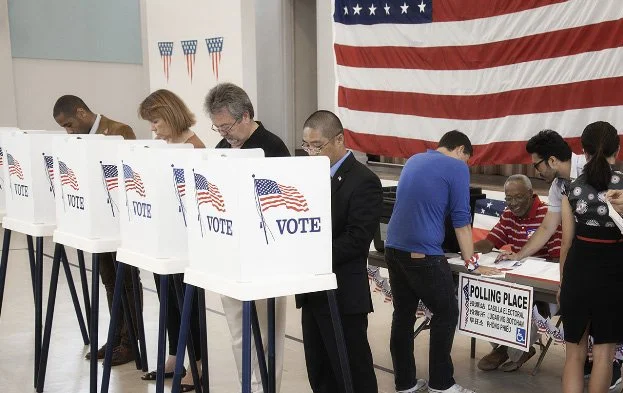
Students and Faculty Prepare for Upcoming Midterm Elections
By Siri Chung ’28
On November 3, voters will head to the polls to cast ballots in the 2026 midterm elections. At stake is control of Congress, with Republicans fighting to maintain their majorities in the House of Representatives and the Senate and Democrats hoping to win back control. All 435 House seats and 35 Senate seats are up for election, with tightening races across the country. According to the non-partisan newsletter Cook Political Report, recent polling indicated that 18 House races have shifted to favor Democrats, with new projections predicting that Democrats will pick up 19 seats. In the Senate, where Republicans hold a 53-47 majority, six of the seven seats considered toss-ups are currently Republican-held. With issues such as the economy, immigration, and healthcare on the minds of voters, these midterm elections have the potential to redirect President Donald Trump’s last two years in office.
As election day approaches, Milton students are paying attention to the races in varying degrees. Milton Progressives Co-Head Lyra Dvorin ’28 follows the midterm elections “as closely as possible.” Committed to researching candidates, particularly those involved in swing states such as Ohio and Texas, she argues that “the outcome of this election could truly shape what we see in our country for the next two years and define what the rest of the second Trump Administration will look like.” Dvorin pays close attention to immigration enforcement, and she believes that this election could place restrictions on ICE through funding control. Freedom of the press is also on Dvorin’s mind, given the Trump administration’s limiting access to reporters and conducting antitrust investigations against television networks. Dvorin has been “encouraging people to get out the vote,” knowing how high the stakes are.
Rynn Wilson ’29 is also politically engaged around the midterms. As a representative of GenZ4Healey, a junior campaign committee supporting Maura Healey’s campaign, Wilson has raised awareness and engaged youth in politics through “posting on Instagram, phone banks, text banks, collecting signatures, and sometimes even political events.” Both the economy and the war in Iran matter to Wilson, and she reports a broad concern over the balance of power in our government: “If no proper balance is achieved in the election, then we may be facing some huge threats to our democratic future,” she says. “We are at a pivotal point in our democracy.”
Solomon Fleiss ’28 notes that an incumbent President’s party has not won the midterms since 2002, so he has “no expectations of a Republican party win in November.” He contends, however, that the scale of the Democratic wins will test the President’s popularity. He also thinks that in the “likely event of a Democratic victory, the House will push quickly for a vote of impeachment of the President.”
Other students, however, such as Evelyn Landis-Arnold ’30, feel discouraged from paying attention to election news because of the political environment. Though she hopes the Democrats will flip Congress, Landis-Arnold finds the current political scene intimidating: “I have been trying to follow but not too closely, because every time I open any news or go looking for information on anything politics, it is just depressing thing after depressing thing.”
When asked about students’ political engagement, Dr. Perin Gokce, a member of the History Department and faculty sponsor for the Public Issues Board, explains, “It’s hard because some students aren’t old enough to vote yet. [But for] those who are voting for the first time, this could be like a really interesting election.” She argues that political awareness is critical for intelligent voting. “This is your country, your future. [B]eing engaged and being informed, and when it’s your turn to vote, having access to information, it’s really important.” She also urges students to fact-check their social media news feeds against mainstream news outlets
According to Gokce, affordability is a top issue for voters in this election. “People are feeling the impact of inflation. Prices are higher than they used to be, so they’re paying more for eggs, more for groceries, and gas.” But larger issues about the health of our democracy are also on her mind. “Do people trust the political institutions?” she wonders. “Do people approve of the President’s immigration policy and crackdown? I think this election will tell us how voters are feeling around these really important questions.” In addition, she believes a big concern for many voters is how the Trump administration has politicized the judiciary, using the Office of the Justice Department to go after political rivals.
Similarly, History Department Chair Mr. Joshua Emmott echoes concern about corruption in the political atmosphere. “The level of corruption in politics is unprecedented in [our] lifetime,” weakening democratic institutions and creating a “world order that is unstable.” For Mr. Emmott, “democracy and the rule of law” are top issues in this election, along with American foreign policy, particularly toward Venezuela, Canada, and the Middle East.
Economic issues, including the impact of tariffs and artificial intelligence (AI) on the economy, also matter to Mr. Emmott. “AI and social media corporations are inherently anti-democratic and are creating a society that ignores the ‘consent of the governed’ and, instead, consolidate power in the hands of a few men whose singular objective in life is to accumulate as much money and power as they can,” he argues, “regardless of the costs to people, society, or the environment”.
History Department faculty member Robert McGuirk identifies inflation as a major consequence of the “reckless” war in the Middle East but believes Republicans will continue to center on the issue of immigration in their midterm messaging. He predicts that, if seats are flipped in Congress, as he thinks they will be, “Republicans, primarily Trump, will declare the votes are fraudulent” in an attempt to maintain power.
Efforts to inform the community about the election will continue. On October 29th at 7:30 pm in Straus, the Public Issues Board will host Harvard Law Professor Nick Stephanopoulos, who specializes in election law. Among other issues, he will speak about the design of our democracy and the implications of election law in the midterms, including voter rights and election integrity.
Likewise, on Tuesdays, Progressive Club meets to discuss the midterms and plan initiatives. Co-Head Niamh O’Donoghue ’28 is leading a non-partisan voter registration campaign aimed at aiding Milton students with pre-registering and registering to vote. She explains, “People over 16 can pre-register, which is a great step toward eventually voting.”
Two weeks away, this fall’s midterms promise to be packed with action. “I am watching closely,” Dr. Gokce says. “I hope students will watch closely, too.”
Source: Public Policy Institute of California