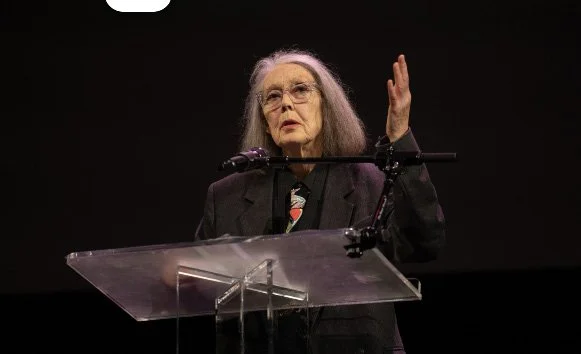
Anne Carson Wins the Nobel Prize in Literature
By Annabelle Chen ’28
On Thursday, October 8, Anne Carson—poet, professor, classicist, translator—was awarded the Nobel Prize in Literature.
Cultivating a strikingly honest and brilliantly eloquent voice, Carson has written more than twenty books, including poetry, essays, and translations of Greek literature. Much of her work, however, defies these simple genre categorizations; Autobiography of Red, for example, is a bildungsroman novel-in-verse that follows a modern adaptation of the mythological Geryon. Carson writes in a manner that bridges the distinction between lecture, theater, and performance art (“Norma Jeane Baker of Troy,” “Lecture on the History of Skywriting”). Classics teacher Ms. Jeanna Cook noted that Carson’s translation of Sappho’s fragments, If Not, Winter, revolutionized her understanding of translation as not only a means of understanding but also a form of art. Additionally, Cindy Zeng ’27 highlighted another aspect of Carson’s translation style, noting that it often evokes a “blend of Carson’s voice and the original author’s voice.”
Carson’s voice is, simply put, unconventional. Ms. Lisa Baker of the English department described Carson as “daring,” while Ms. Alex Mina of the Classics department “respected [Carson’s] determination of self.” The general consensus of the internet labels her as “weird.” Upon finding out that she had been awarded the Nobel, Carson’s reaction was “Yikes.”
While Carson herself may not have expressed immediate excitement, many were thrilled at her receiving the award. English Department faculty member Mr. Brian Simoneau stated that it was “long overdue,” and Zeng noted that Carson was a “superb pick” for the award, describing the Nobel Prize in Literature as “confirming and celebrating the literary stature of a writer that has already achieved greatness.” According to the Nobel Prize Organization, Carson’s Nobel was officially awarded “for her bold and inventive oeuvre that, in playful dialogue with the classical tradition, has created new forms for contemporary literature.” What sets Carson apart from other poets, translators, and classicists is her uniquely unafraid blend of characteristics: the act of translation, as well as the act of writing poetry and analyzing sources, is a very particular one, requiring specificity of intent, thought, and feeling. Zeng highlighted the extreme precision and intimacy of Carson’s writing as being influenced by her work as a translator, describing her as “transgressive” not only in her experimentation with form but also in her crossing the classical with the modern. Carson’s own take on the latter seems shocking at first: in an interview regarding Carson’s initial reaction to her award, she explained how rather than focusing on the classical world’s relevance today, she is “interested in us being relevant to them.” Such an approach deviates from the typical perspective, especially given the despondent decline of classics as a field, resulting in work that transcends the boundaries of ancient and modern times, bringing the reader much closer to the classical world.
In the same interview, Carson repeated the mantra to “start in the middle,” as advice not only for other writers but also for those interested in reading her work; many start with Autobiography of Red, arguably one of the most approachable to those who are not fanatical about translation or classics. Zeng recommended “The Glass Essay,” a long-form poem/essay available on The Poetry Foundation. If you’re new to Carson, I’d recommend starting with her poetry (Autobiography of Red and “The Glass Essay” are good choices); while Carson has published brilliant scholarship, such as Eros the Bittersweet, her first book and originally her doctoral thesis, much of it depends on a pre-existing knowledge of classics. My personal recommendation from her analytical work would be “The Gender of Sound,” which is the last piece in her collection Glass, Irony, and God and insightfully tracks the gendered association of different sounds over time.
Source: UC Berkeley